


FAQ – What Is the Best HunterLab Solution for Non-Uniform, Heterogeneous, and Difficult-to-Measure Samples?
Answer
For materials that are highly variable, textured, irregularly shaped, or difficult to measure consistently using traditional contact-based instruments, the Aeros® is HunterLab's preferred solution. Aeros® combines non-contact measurement, a rotating sample stage, and automatic large-area averaging to provide representative color measurements on products where sample variability is often the largest source of measurement error.
How Much Does It Cost?
The Aeros® starts at approximately $20,610.
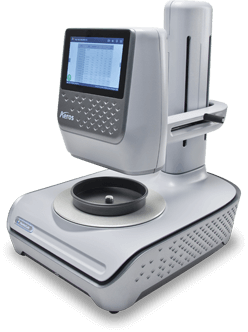
The system is specifically designed to address measurement challenges associated with heterogeneous products that cannot be reliably characterized using traditional spot measurements.
What Is the Typical ROI of Using Aeros®?
Though exact numbers vary significantly by customer and industry, organizations commonly achieve savings through:
- Reduced product giveaway
- Improved process consistency
- Reduced visual inspection variability
- Reduced customer complaints
- Improved product grading accuracy
- Reduced operator-to-operator variation
Many organizations achieve payback within 6–18 months.
For highly variable products, improving measurement repeatability often provides greater value than improving instrument precision alone.
Why Would I Choose Aeros®?
Many products are inherently difficult to measure because no two samples look exactly alike. Traditional color measurement systems typically evaluate a relatively small area of the sample. For highly heterogeneous materials, small changes in sample presentation can produce significant measurement variation.
Aeros® addresses this challenge by measuring a much larger representative sample area while automatically averaging multiple measurements during sample rotation.
The result is often a more representative measurement of the product that better correlates to how customers visually evaluate it.
What Makes Aeros® Different?
Non-Contact Measurement
Unlike traditional contact-based instruments, Aeros® measures samples without touching them. This approach helps:
- Eliminate sample compression
- Reduce presentation variability
- Accommodate irregular surfaces
- Improve measurement consistency
while simplifying sample preparation.
Rotating Sample Stage
Aeros® automatically rotates the sample during measurement. This allows the instrument to evaluate multiple viewing angles and sample locations, reducing the influence of localized variation. This is particularly important for products where color and appearance vary naturally across the sample.
Large-Area Averaging
One of the greatest advantages of Aeros® is its ability to average color across a larger representative area. Rather than measuring a small spot, Aeros® evaluates a broader sample region, helping reduce variability caused by:
- Particle distribution
- Product shape
- Surface texture
- Color non-uniformity
Improved Correlation to Visual Evaluation
Consumers rarely evaluate a single point on a product. Instead, they evaluate the overall appearance of the product. By measuring larger representative areas, Aeros® often provides results that better correlate to customer perception and product grading systems.
What Are the Best Practices for Using Aeros®?
- Measure representative production samples.
- Use consistent sample loading procedures.
- Fill sample trays uniformly.
- Avoid segregating particles by size or color.
- Establish approved production standards.
- Monitor CIELAB (L*, a*, b*) routinely.
- Monitor ΔE color difference.
- Standardize the instrument regularly.
The goal is to evaluate the product as a customer would see it rather than focusing on a single measurement location.
Are There Any Special Considerations?
Aeros is Particularly Valuable for Food Products
Food products often exhibit natural variation in:
- Shape
- Size
- Surface texture
- Color distribution
Aeros® was designed specifically to address these challenges.
Aeros is Ideal for Difficult-to-Measure Materials
Aeros® is frequently selected when customers struggle with:
- Poor repeatability
- High operator variability
- Sample presentation challenges
- Inconsistent measurements between laboratories
In many cases, the issue is not the instrument—it is the sample.
Aeros® Key Capabilities
- Non-contact measurement
- Rotating sample platform
- Automatic large-area averaging
- Excellent repeatability on heterogeneous materials
- Reduced operator variability
- Representative measurement of irregular products
- On-board EasyMatch® Essentials L2 Color QC Software
- Optional EasyMatch® Quality Central Enterprise Software
Typical Applications
Food Products
- Potato chips
- Tortilla chips
- Crackers
- Cookies
- Cereals
- Nuts
- Seeds
- Pet foods
- Snack foods
- Spices and seasonings
- Roofing granules
- Granular materials
- Textured products
- Heterogeneous materials
- Irregularly shaped products
- CIELAB (L*, a*, b*)
- ΔE Color Difference
- Hunter L, a, b
- Yellowness Index
- Whiteness Index
- Spectral Reflectance
Key Takeaway
Aeros® is HunterLab's preferred solution for non-uniform, heterogeneous, and difficult-to-measure samples. By combining non-contact measurement, sample rotation, and large-area averaging, it helps manufacturers obtain more representative and repeatable measurements on products where natural variability makes traditional color measurement difficult.
Do you need more information? Submit a ticket and a support team member will reach out to you soon!
To learn more about Color and Color Science in industrial QC applications, click here: Fundamentals of Color and Appearance