


The best HunterLab solution for measuring the color of food ingredients is ColorFlex® L2. Designed for routine quality control of powders, granules, flakes, pastes, emulsions, and opaque liquids, ColorFlex® L2 uses industry-standard 45°/0° geometry to provide excellent correlation to visual appearance while delivering fast, objective, and repeatable measurements. It helps manufacturers verify raw materials, monitor processing, detect formulation changes, and ensure consistent ingredient quality before products are incorporated into higher-value finished foods.
How Much Does ColorFlex® L2 Cost?
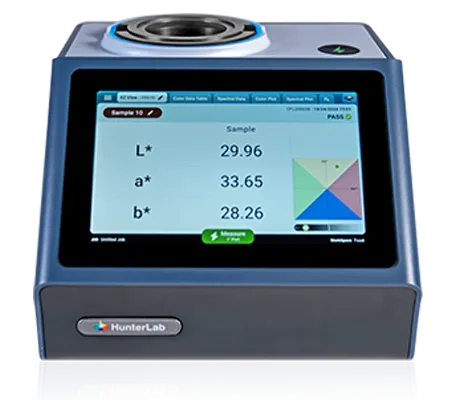
ColorFlex® L2 starts at approximately $13,340.
What Is the Typical ROI for ColorFlex® L2?
Though exact numbers vary significantly by manufacturer and production volume, food ingredient manufacturers commonly achieve savings through:
- Reduced scrap and rework
- Earlier detection of process variation
- Improved ingredient consistency
- Reduced customer complaints
- Reduced supplier variability
- Reduced visual inspection variability
- Improved process control
- Reduced formulation errors
- Standardized quality across multiple production facilities
- Raw material variation
- Improper roasting or drying
- Incorrect formulations
- Oxidation and aging
- Contamination
- Batch-to-batch inconsistency
Many manufacturers find that preventing a single off-spec production lot or customer rejection can justify the investment in objective color measurement.
What Sets ColorFlex® L2 Apart?
Within a single platform designed for routine food ingredient quality control, ColorFlex® L2 combines:
- Industry-standard 45°/0° annular geometry
- Excellent correlation to visual appearance
- Fast pass/fail measurements in seconds
- Sealed enclosure and optics for demanding food production environments
- Integrated camera for accurate sample positioning
- Measures CIELAB (L*, a*, b*), ΔE, Hunter Lab, XYZ, Yellowness Index, Whiteness Index, and numerous food-specific color scales and indices
- Multiple sample accessories for powders, granules, pastes, emulsions, and opaque liquids
- On-board EasyMatch® Essentials L2 Color QC Software
- Optional PC-based EasyMatch® Quality Central Enterprise Color QC Software
Together, these features provide objective, repeatable measurements that improve ingredient consistency, reduce waste, and eliminate subjective visual inspection.
What Food Ingredient Applications Are Ideal for ColorFlex® L2?
ColorFlex® L2 is ideally suited for measuring the color of:
- Flour
- Sugar
- Salt
- Starches
- Protein Powders
- Milk Powders
- Cocoa Powders
- Tea Powders
- Spice Blends
- Seasonings
- Vegetable Powders
- Fruit Powders
- Dry Ingredient Blends
- Opaque Sauces
- Food Pastes
- Emulsions
- Bakery Mixes
- Nutritional Ingredients
- Functional Food Ingredients
Why Measure the Color of Food Ingredients?
Color is one of the earliest indicators of ingredient quality and manufacturing consistency. Customers associate consistent ingredient color with:
- Proper processing
- High product quality
- Accurate formulation
- Reliable suppliers
- Consistent finished products
- Raw material variation
- Improper roasting or drying
- Oxidation
- Contamination
- Formulation errors
- Process variation
Objective color measurement allows manufacturers to identify problems before ingredients are incorporated into higher-value finished products, reducing waste and improving overall product quality.
Are There Any Special Considerations for Measuring Food Ingredients?
Food Ingredients Come in Many Forms
Food ingredients present a wide range of measurement challenges, including:
- Different particle sizes
- Variable surface texture
- Uneven color distribution
- Natural seasonal variation
- Powders that pack differently
- Opaque liquids and emulsions
- Multi-ingredient blends
These variations make subjective visual inspection inconsistent and difficult to standardize.
Standardized Measurement Improves Consistency
Developing standardized sample preparation procedures and objective color tolerances allows manufacturers to:
- Verify incoming raw materials
- Monitor roasting, drying, milling, and blending operations
- Detect formulation changes earlier
- Improve supplier qualification
- Maintain consistent product quality across multiple facilities
Objective color measurement provides an early indication of process variation before higher-value products are affected.
What Are the Best Practices for Measuring the Color of Food Ingredients?
- Develop objective color standards and tolerances.
- Measure representative samples using standardized preparation methods.
- Use consistent sample presentation and packing procedures.
- Measure products under controlled environmental conditions.
- Trend color data to identify long-term process drift.
- Standardize methods across all manufacturing sites.
- Verify incoming ingredients before production.
- Confirm finished ingredient color before packaging or shipment.
Consistent measurement procedures improve repeatability while enabling earlier detection of process variation and strengthening quality assurance programs.
Key Takeaway
For food ingredient manufacturers, ColorFlex® L2 provides fast, objective, and repeatable color measurements that improve ingredient consistency from incoming raw materials through finished products. Its industry-standard 45°/0° geometry, sealed optical system, integrated camera, multiple sample accessories, and modern quality control software help manufacturers reduce waste, replace subjective visual inspection, strengthen supplier qualification, and ensure every ingredient meets customer expectations.
Access our free HunterLab Color Quality Business Case Calculator™ – Professional Edition, a practical decision-support tool designed to help manufacturers quantify the financial value of objective color quality control: HunterLab Color Quality Business Case Calculator™
Would you like to learn more? Contact us and we'll help you find the best solution for your needs.
For support related questions, submit a support ticket and one of our technical support engineers will contact you as soon as possible!
To learn more about Color and Color Science in industrial QC applications, click here: Fundamentals of Color and Appearance